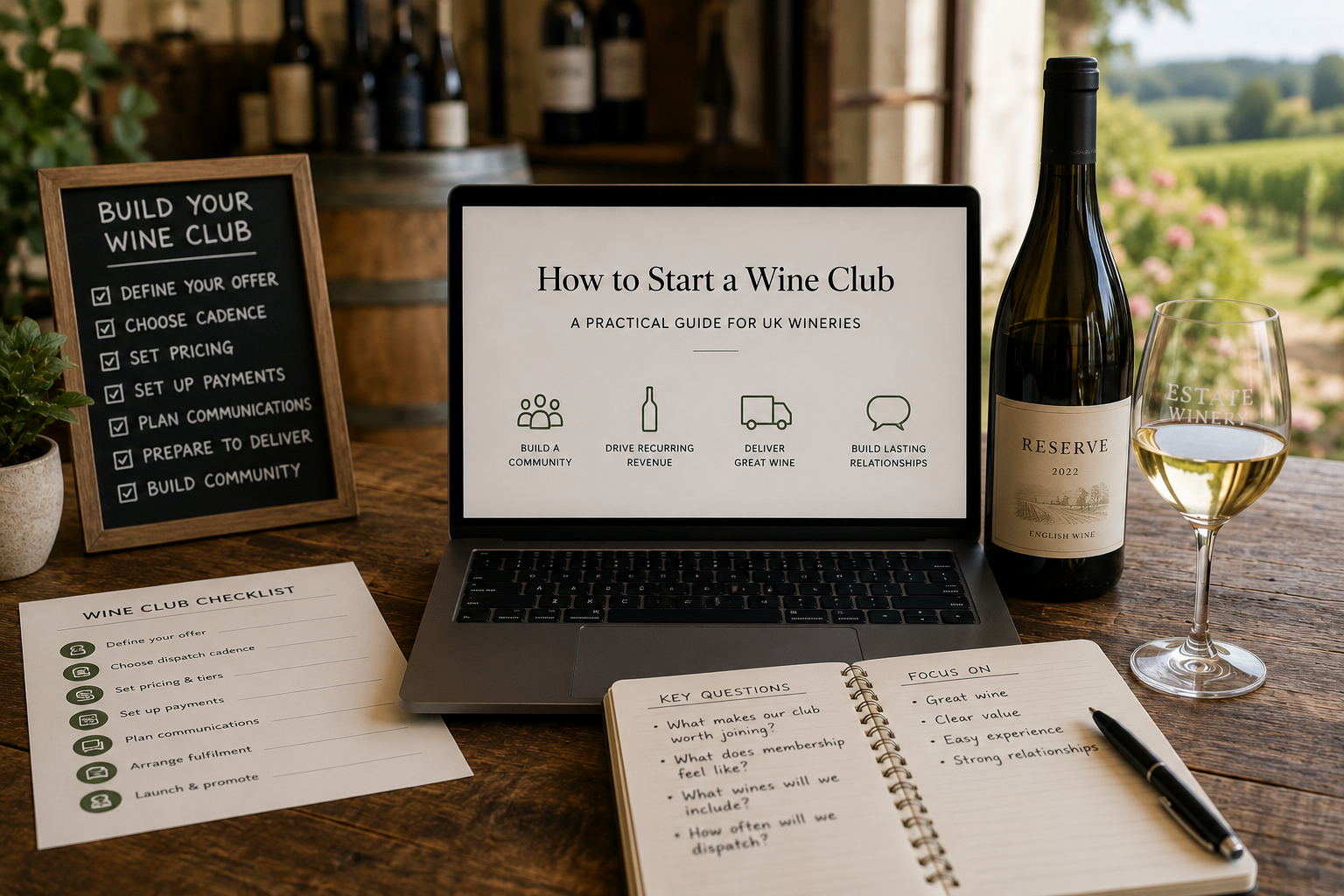
Starting a wine club is one of the best things a winery can do for its DTC business. Done well, it creates predictable recurring revenue, builds a community of genuinely engaged customers, and gives you a direct relationship with the people who care most about your wine.
Done badly, it creates an administrative headache that takes more time to run than it generates in value.
This guide covers what you actually need to think about before launching - the decisions that matter, the things that catch people out, and how to set it up so it runs smoothly rather than becoming another job.
Before you launch: the decisions that matter
What are you actually offering?
The most common mistake is launching a wine club without being clear about what members are signing up for. "A box of wine every quarter" is not a proposition. "First access to our new releases, including wines that never make it to retail, selected by us and delivered to your door" is a proposition.
Before anything else, get clear on:
- What makes your club worth joining? What do members get that they can't get elsewhere?
- Is the primary appeal access to limited releases, the convenience of regular delivery, the connection to you and your winery, or a combination?
- What does membership feel like beyond the wine?
The answers shape everything else - your pricing, your communications, your events, how you talk about the club.
How often will you dispatch?
Quarterly works well for most clubs. It's frequent enough to maintain engagement and generate meaningful recurring revenue, but not so frequent that it creates fulfilment pressure.
Monthly works if you produce a wide enough range and your members are enthusiastic enough - but it requires significantly more operational capacity and is harder to sustain. Twice a year is a reasonable starting point for smaller operations.
Think honestly about your own production volumes. A club of 100 members receiving 6 bottles quarterly means 600 bottles per cycle. Can you sustain that without putting pressure on your retail stock?
How many tiers?
You don't need multiple tiers from day one. Starting with one well-defined club is simpler to manage and easier to communicate. You can add tiers later once you understand what your members actually want.
If you do launch with tiers, keep the distinctions meaningful. "6 bottles or 12 bottles" is a meaningful difference. Subtle differences in bottle count with marginal price differences are confusing and hard to sell.
What will you charge?
Pricing a wine club is partly about margin and partly about perceived value. A few principles:
Members should feel they're getting value relative to buying the same wines at retail. A small discount on the retail price, priority access to limited releases, or free delivery are all legitimate ways to make the maths feel good for members without destroying your margin.
Don't undercharge in an attempt to attract members. Cheap wine clubs attract price-sensitive members who cancel the moment they can find something cheaper. Members who pay a fair price for something they value stay longer.
Think about the annual value per member. At £60 per quarter, a member is worth £240 per year. That's worth taking seriously.
Setting up the mechanics
Member sign-up
Keep sign-up simple. Members need to understand what they're getting, know what it costs, and be able to join quickly. The more decisions you ask them to make upfront, the more people drop off before completing.
Payment and billing
Recurring billing is not something you want to manage manually. From day one, use a payment processor that handles recurring charges automatically - Stripe is the most commonly used and integrates with most wine club software. GoCardless is worth considering for direct debit, which has lower failure rates than card payments for recurring billing.
Card payments fail. Someone changes bank, their card expires, a fraud check triggers a decline. You need a system that automatically retries failed payments, notifies the member, and gives them an easy way to update their details - without requiring you to chase people individually.
Fulfilment
How will orders get from you to your members? For smaller clubs, self-fulfilment from the cellar door is manageable. As numbers grow, a third-party logistics provider becomes worth considering.
If your wine is stored under bond, integrating your club management software with your bonded warehouse removes the manual step of sending orders across. Marzipan integrates directly with London City Bond, which handles pick, pack and dispatch automatically.
Member communications
Three communications matter most:
Welcome email. Warm, personal, sets expectations. When will their first delivery arrive? What should they expect? Who can they contact if they have questions? This is the first impression of membership - make it feel like joining something rather than completing a transaction.
Pre-dispatch notification. Sent a week or two before each dispatch. What's in the box and why. This is often the most-read email you'll ever send. It's also when members who want to skip or make changes will do so, so make it easy for them.
Dispatch confirmation. What's been shipped, when it will arrive, tracking reference. Brief and functional.
Everything else - events invitations, vintage updates, behind-the-scenes content - builds the relationship over time. But get those three right first.
The things that catch people out
Not having a clear pause and cancellation process
Members will need to pause or cancel. Life changes - someone goes on sabbatical, moves house, has an expensive few months. If the process is unclear or requires them to email you, some of them will simply ignore the billing and resent you for it. Others will cancel their card and create a payment dispute.
Be explicit about how members pause or cancel. Make it easy. The Digital Markets, Competition and Consumers Act 2024 is also bringing in legal requirements for subscription businesses to make cancellation as easy as sign-up, coming into force in Autumn 2026.
Overselling limited stock
If a release is limited, be honest about that from the start. Members who are told a wine is exclusive to the club and then see it on the shelf at a local restaurant feel deceived - and they will tell people.
Underestimating dispatch day
The first dispatch day is always more work than expected. Give yourself more time than you think you need. If you're self-fulfilling, a team of two can typically pack around 50-60 boxes in a day - plan accordingly.
Forgetting to tell anyone the club exists
Launching a wine club and then waiting for people to find it doesn't work. Tell your existing customers first - they're already warm to you. Use your mailing list, your cellar door, your social channels. Ask your best customers to share it.
What software do you need?
For a club of fewer than 20-30 members, a spreadsheet and a manual billing process will work in the short term. It's not ideal, but it's functional.
As soon as the club grows, dedicated wine club software becomes significantly easier than the alternatives. It handles recurring billing, member self-service, dispatch management, and the communications that need to go out at each stage of the cycle.
Marzipan is built specifically for this - wine clubs, DTC sales, events, and CRM in one platform, built in the UK and hosted in the EU.
If you want to go deeper on choosing a platform - what to look for, where your member data lives, and how the pieces fit together - our complete guide to wine club software for UK wineries covers it in detail.