We recently built a free tool that grades a winery's website on the things that decide whether a visit turns into a sale. Before pointing anyone at it, we wanted to know what normal looks like. So we ran it over every UK winery website we could find.
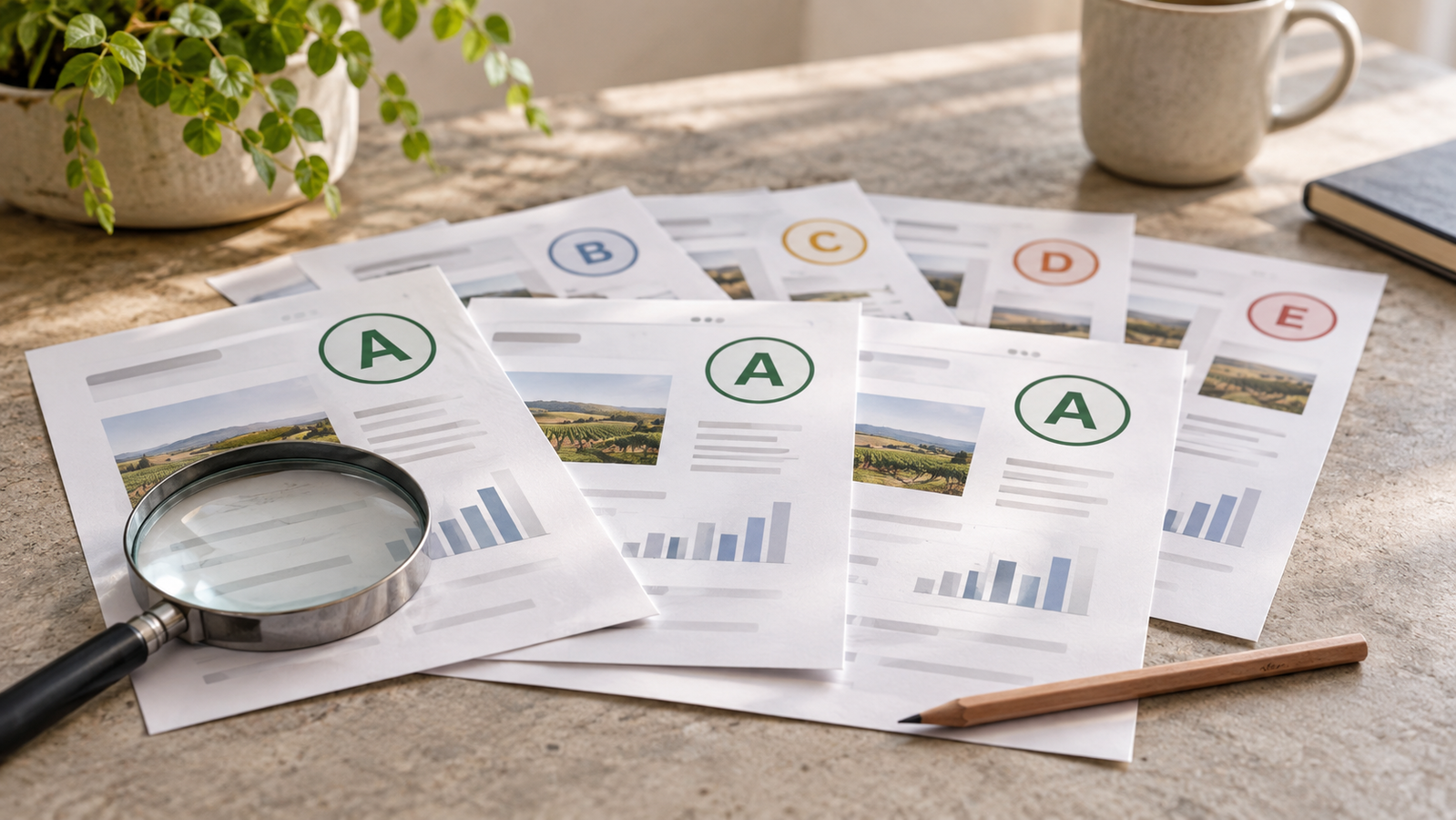
Of the 307 sites we could check in full, only three scored an A.
Want to see how yours compares? It's free and takes a minute.
Check your websiteThe grades
| Grade | Score | What it means | Sites | Share |
|---|---|---|---|---|
| A | 85+ | Getting nearly everything right | 3 | 1% |
| B | 70 to 84 | Good, with a few gaps | 78 | 25% |
| C | 55 to 69 | Does the job, but with clear room to improve | 122 | 40% |
| D | 40 to 54 | Several things holding it back | 83 | 27% |
| E | Under 40 | Needs the most work | 21 | 7% |
The score out of 100 is made up of speed (35), selling online (20), trust and compliance (15), wine club (10), search engines (10) and email signup (10). A site scoring under 50 for mobile speed can't get above a B.
The average score was 60 out of 100, and more than a third of sites got a D or an E. That's not a reason to feel bad about your website. It's closer to good news: most of what drags these scores down is fixable, and if you fix it you'll be ahead of most of the wineries you compete with.
Most sites are slow on a phone
The average mobile score from Google's PageSpeed test was 62 out of 100, against 76 on desktop. Only 7% of sites scored 90 or above on mobile, and more than a fifth scored under 50.
The number that stood out was how long the main image or headline takes to appear. Google's target is 2.5 seconds, and 91% of sites missed it in Google's mobile test. The median was 9.6 seconds. That test simulates a mid-range phone on a slow connection, so plenty of visitors will see something quicker, but someone on patchy signal in the countryside won't.
It matters because small differences add up. A Deloitte study of 37 brands found that making a mobile site just 0.1 seconds faster led to 8.4% more retail customers buying.
Photos are usually the culprit. The median home page weighed 3.4MB, 31% were over 5MB, and 37 sites were over 10MB. The heaviest was 90MB, which is a lot to ask of anyone's phone before they've seen a single bottle.
Selling, and being able to sell again
Most sites let you buy something, but 12% had no shop at all. Fewer still give people a reason to come back:
- Only a quarter had a wine club we could find. A club is the most predictable revenue most wineries can have, so three in four are either missing out or hiding it.
- 45% had no email signup form. Most visitors won't buy first time, and without an email address you have no way of reaching them again.
A few basics were missing too. 36% had no privacy page we could find, and 33% load tracking with no cookie banner that we could detect.
Ready for AI search?
More people are starting to ask ChatGPT and its rivals what to buy, and AI agents are starting to browse on people's behalf. Most winery websites aren't set up for that yet:
- 67% failed Google's check on whether an AI agent can follow the structure of the page.
- Only 38% publish product data in a form that search engines and AI tools can read, such as prices and stock.
We show AI readiness on every report but don't let it affect the grade yet, because it's still early. Product data is the exception: it helps with ordinary Google results today, so it does count, and it's worth fixing now.
Does the platform matter?
A little.
| Platform | Sites | Average score | Mobile speed | Median page weight |
|---|---|---|---|---|
| Shopify | 65 | 70 | 67 | 3.1MB |
| Wix | 31 | 61 | 67 | 3.1MB |
| WordPress | 115 | 59 | 59 | 4.0MB |
| Squarespace | 49 | 59 | 54 | 3.6MB |
Shopify scored best overall, which makes sense when a shop and checkout come built in. But the gap between platforms is small next to the gap between an A and an E.
How a site is built matters more than what it's built on. Bloated plugins, heavy theme scripts, oversized photos and a stack of tracking tags can slow a site down on any platform.
Where to start
If you only do three things:
- Shrink your photos. Resize them to the width they're shown at and save them as WebP. It's the biggest speed win for most sites.
- Add an email signup with a reason to join. "First access to the new vintage" beats "join our newsletter".
- Try buying your own wine on your phone. Fix the first thing that gets in your way.
Then run your own check to see where you stand and what to fix first.
How we did this
We started with a list of 353 UK winery and vineyard websites and ran each one through our website check in November 2026. We could check 307 in full. Another 27 blocked automated visits, and 19 couldn't be reached. Speed figures come from Google's PageSpeed Insights, and cover 300 of the 307 sites. Everything else comes from what we could detect automatically on each site, so a wine club or signup form that's well hidden may have been missed. Which is arguably the same problem.
The grades are our own, based on what we think matters for selling wine online.